
Divorce Decree records in Sedgwick County can be retrieved in minutes using the online portal, which indexes Sedgwick Countydivorce decree search results by case number, filing date, and party name. The system pulls from Sedgwick Countycourt records and Sedgwick Countyfamily court records, delivering a certified copy or an uncertified copy as requested. Users see the final divorce judgment date, property division terms, and child custody provisions without leaving home.
Accessing a Sedgwick Countydivorce decree copy online eliminates the need to visit the clerk office, and the site displays the divorce decree by date, by court, and by case number for quick verification. Whether you need a certified divorce decree for legal use or an unverified copy for personal reference, the portal shows associated divorce judgment records, custody orders, and spousal support details, helping you confirm the decree’s authenticity instantly.
How to Search Divorce Decree
A divorce decree is a court order that ends a marriage and states the terms approved by the judge. A Sedgwick County search helps locate the case linked to that order, confirm key case details, and identify the next step for obtaining a copy. Users can also reference deed files for additional information. An online result is a starting point for case verification, not a substitute for a signed court document or a clerk-certified copy.
Official Search Portal: https://www.dc18.org/records
Steps to Search
- Open the Sedgwick County District Court records page and choose the court-record search function.
- Enter the divorce case number when it is available. If it is not, search by one party’s legal name and use the case-type and date controls shown on the portal.
- Open each matching case and compare the case number, party names, court, filing date, judgment date, and document title.
- Locate the decree or divorce-order entry that follows the judgment. Note whether the portal offers an image, a downloadable copy, or only case details.
- Use the case number and entry date to request a clerk-issued copy when the decree cannot be viewed or a certified copy is required.
What a Sedgwick County Divorce Decree Record Shows
The signed decree and the case index serve different purposes. The index locates a case and lists events connected to it. The decree contains the court’s actual language about the divorce and any approved terms. Reviewing both prevents a party from treating a docket entry as the full order.
Divorce records contain important information about the end of a marriage and the court’s decisions. The entered divorce decree is the signed court order that ends the marriage and outlines terms related to property, debts, children, or support. The case index and docket history show case details, filing dates, hearings, and other court activity. Check the case number, document title, judge, and entry date to identify the correct record.
Property and debt provisions explain how marital assets and liabilities are divided. Custody, parenting time, and child support terms describe parental responsibilities, visitation schedules, and financial obligations. Spousal support terms outline payment amounts, duration, and conditions. Later modification orders may change these original arrangements. A marriage certificate documents the marriage itself and is separate from the divorce decree.
Similarly, a deed or property record provides ownership information but does not independently confirm how property was awarded in a divorce. Check the relevant court orders and official records to verify the current legal terms. A decree may refer to supporting papers, financial affidavits, property orders, or parenting plans filed with the case. Those documents may carry separate dates and may not appear in a basic case index.
A request for the “divorce decree” should name the exact document and date when the intended document is uncertain. Kansas law under K.S.A. 60-040 treats a decree of divorce as final when filed with the clerk, subject to the statutory routes for revision. A date displayed in an online index may describe the ruling, entry, or posting event instead of the clerk’s filing date. A person who needs the legal date for a filing, settlement, or agency request should confirm it from the filed decree.
How to Read Property, Custody, and Support Terms
The wording in the entered decree controls what the court ordered. Search summaries, proposed agreements, and petition drafts do not carry the same legal effect. A records search can identify these documents, yet the court file remains the source for the operative language.
Property Division and Debt Allocations
K.S.A. 60-051 directs Kansas courts to divide marital property fairly after considering the parties’ debts and liabilities. The decree may identify the family home, vehicles, bank accounts, retirement assets, personal property, and responsibility for debts. Defined terms can point to a property schedule or another attached order, so a complete review may require more than the first page.
A property allocation states the court’s division between the spouses. It may not by itself change a creditor’s account records, transfer title to real estate, or complete a retirement division. Deeds, title records, account statements, and other filed documents can be needed to carry out the decree. The exact wording should be compared with any later order that changed property or debt terms.
Child Custody, Support, and Parenting Time
Child-related terms can include legal decision-making responsibility, residential parenting time, holiday schedules, exchange locations, and child support. Depending on the case date and the wording used by the court, an older file may use terms such as “custody,” “visitation,” or “conservatorship.” The label alone does not explain the full arrangement, so the decree’s definitions and schedules should be read together.
A child support provision may identify the payer, recipient, amount, due date, duration, and review terms. A support worksheet, financial affidavit, or payment record may be filed separately. The decree proves what was ordered but does not prove that payments were made. A missed payment is a separate enforcement issue that may require a new filing or court action.
Spousal Support and Later Changes
Spousal support, also called maintenance in some Kansas filings, can address the amount, payment frequency, start date, duration, review date, and insurance or tax treatment. The decree may contain a clause for review after a specified event or period. A party should search the complete case history because a later support order may control after the original decree was entered.
A post-judgment modification is not an automatic change to a decree. Kansas law permits certain changes when the statutory requirements are met, and a court must approve a substantive change. Clerical corrections to names or dates differ from disputes over support, property, custody, or parenting time. A search for later orders helps identify the current terms without making a legal interpretation.
Judicial Approval and Key Dates
A petition, settlement proposal, or hearing result does not become the decree until the court signs it and the clerk files it. The signature and filing mark show that the court acted on the case. Looking for the decree document after the judgment event helps distinguish the signed order from a request, notice, or proposed agreement.
Search results may display more than one date. The filing date records when the clerk received the decree. A judgment date records the court’s ruling event, and a posting date may reflect the system’s index update. Under K.S.A. 60-040, filing with the clerk marks the decree as final. If those dates conflict or a legal deadline depends on them, request a certified copy and ask the clerk which event date appears on the filed document.
Official Copies and Court Request Procedures
An online search, a document image, and a certified copy perform separate jobs. A search locates the case. An ordinary copy reproduces what the portal displays. A certified copy carries the clerk’s authentication and confirms that it corresponds to the court record.
Identification and Request Details
A public case search and a request for a clerk-issued copy follow different rules. Public viewing does not require a person to become a party to the divorce case. A copy request may ask for the requester’s identity, contact details, the case number, and the document needed. The clerk’s current form or instructions control the exact requirements.
The case number is the strongest record locator because one party’s name may match several cases. A requester should also have the parties’ full legal names, the approximate filing date, and the document title or court event that identifies the decree. Former names, suffixes, and spelling changes can affect a name search. When a request is made for another person, the form may call for that person’s name and the requester’s relationship to the case.
Send identification or financial records only through the official request channel requested by the clerk. You can also consult criminal records to locate official filings. A public search page or an outside records site should not receive sensitive identity documents unless the responsible court agency has directed the requester to that channel.
Fees, Delivery, and Processing Time
Copy charges, accepted payment methods, delivery choices, and processing time can change. Confirm the current total charge and completion estimate before submitting a request. An online case image does not create an instant certified copy, and a portal’s search function should not be treated as a promise of same-day service.
Ask whether the clerk accepts requests through the court’s portal, by mail, or in person. Confirm the payment method, the document to be copied, the number of pages required, the delivery address if a copy will be mailed, and the expected completion date. When a deadline is close, state that fact when requesting service and ask for the earliest authorized option.
Public Availability, Sealed Files, and Corrections
The Kansas Open Records Act, K.S.A. 84-2231 and following sections, generally supports public access to records held by public bodies, subject to statutory, court-rule, and court-ordered exceptions. A public directory and a full case file can therefore have different levels of availability.
Open Case Listings and Sealed Records
A case may appear in the public index even when a document or part of the file is closed. Closure can come from a statute, a court rule, or a specific court order. A sealed file may require authorization, a case number, proof of party status, or a judge’s permission. A public case listing does not remove those restrictions.
Some divorce files contain sealed financial affidavits, personal addresses, protected data, or documents filed under a restricted court procedure. The online index may expose only the case title and basic event data. That limited display does not show the full contents of the filed papers and does not remove the restrictions that apply to them.
Protected Personal and Financial Data
The public index may show less than the paper file, including fewer details about addresses, birth dates, account numbers, income, and child-related financial material. A case search should use only the identifiers needed to locate the correct record. Extra personal data should not be posted publicly without checking the case’s access rules and privacy status.
Financial figures in a decree describe the court’s allocation. They do not reveal later account balances, payment history, tax filings, or enforcement activity. Those subjects may appear in separate records that the portal either lists separately or treats as restricted.
Correcting Clerical and Name Errors
A typo in a case index, party name, document title, or date can create a false mismatch. The records office can review indexing or clerical issues through its correction process. A change to the substance of a signed decree is different because K.S.A. 60-040 treats that decree as a court order. A clerk’s index edit does not change the terms approved by the judge.
A correction request should contain the following items:
- The case number and party names exactly as they appear in the index
- The document title, event date, and clerk’s filing date
- The exact text or data that appears to be wrong
- The correction requested and any supporting paper that shows the correct entry
- A statement showing whether the issue appears in the online index, the docket entry, or the signed decree
Resolving Missing or Conflicting Divorce Decree Results
A missing image or mismatched date does not always mean that no decree was entered. Search results can be affected by a name difference, an indexing delay, a later order, a document restriction, or the selection of the wrong case. Work through the case identifiers and docket sequence before treating the decree as absent.
Matching Case Numbers and Issuing Courts
The case number is the most dependable link between a name search and a court file. Confirm the case number, party names, case type, and issuing court on every result. A search for a “Sedgwick County divorce decree” can still surface a case connected to a different court through a later filing or transferred record, so the issuing court shown on the order matters.
Judicial decisions may come from a different division or judge within the same court system. That difference does not make the result wrong. The party names, case number, and case type should match before any requested document is ordered.
Recent Decree Indexing and Scanning
A recently entered decree may appear after the case index and document images update. The portal may also list a case before every filed paper becomes viewable. Check the result for a later posting date and follow any update notice shown by the records page. If the image remains absent after the portal’s stated cycle, the clerk can confirm whether the document was filed and whether an image or restriction explains the missing item.
Do not conclude that a divorce was never completed solely from a blank result. A decree may exist as a file-stamped paper document even when no online image is posted. The clerk’s file search is the proper route for resolving that difference.
Unlisted and Missing Decree Files
When no case appears, search the exact case number first. If the number is unknown, try the party’s full legal name, former legal name, and spelling used on the court filing. Then confirm the case type and filing year. If those searches fail, the clerk can check whether a decree was entered under another name, moved to a restricted file, transferred from another court, or omitted from the public index.
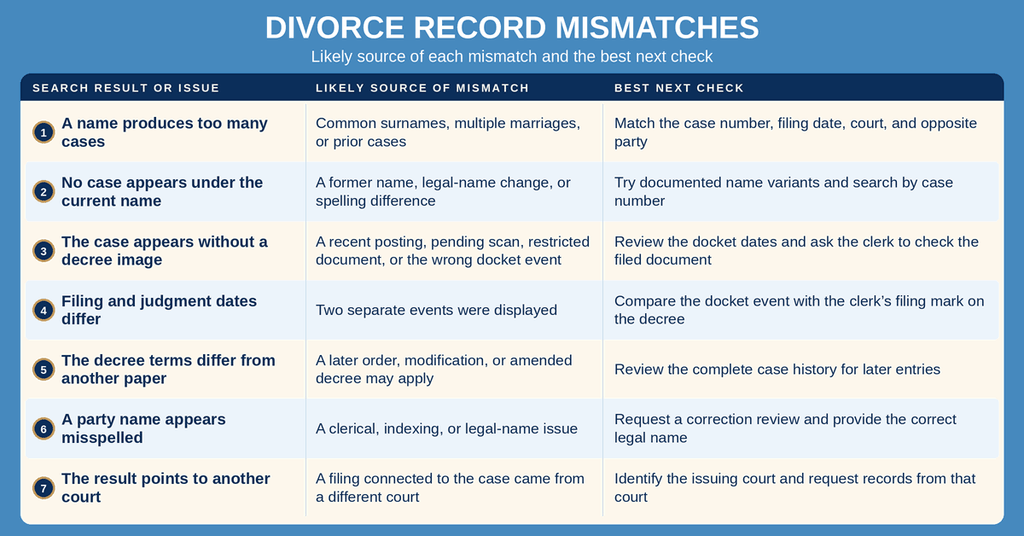
For an unlisted decree, give the clerk the case number, both parties’ names, the approximate filing year, and the expected entry date. Ask whether the decree was entered, what document title the clerk uses for it, whether the file has been scanned, and whether any restriction applies. These steps resolve a records search without replacing a legal review of the decree’s terms.
Contact Details
Use these courthouse details when asking the records office about a divorce decree search, copy request, correction, or restricted case file.
Frequently Asked Questions
Find quick answers about locating, requesting, and receiving divorce decree records in Sedgwick County.
Find a Sedgwick County divorce decree online?
Start with the official search portal at https://www.dc18.org/records. Enter the party name, case number, or filing date to pull the docket entry. The online view shows case status and key dates but not the signed decree. Note that the portal confirms the case exists; you still need to request a certified copy from the clerk’s office for legal use.
What fees apply for a certified copy of the decree?
The clerk charges a standard fee for each certified copy of a divorce decree. Fees cover printing, certification, and handling. Payment can be made by cash, check, or credit card at the office. Exact amounts may change, so call (316) 660-5900 or check the website before visiting.
Request a Sedgwick County divorce decree by mail?
Mail requests are accepted. Write a brief letter that includes the case number, names of the parties, and the desired number of copies. Attach a self‑addressed stamped envelope and the required fee. Send the request to the clerk’s office at 525 N. Main St., 6th Floor, Wichita, KS 67203. Processing usually takes several business days after receipt.
How long for a certified divorce decree copy?
In‑person requests are often fulfilled the same day if the clerk has the record on file. Mail requests typically require three to five business days after the office receives the request and payment. Online requests, when available, follow a similar timeline but may add a few days for electronic verification.
Location of Sedgwick County clerk for decree requests?
The clerk’s office handling divorce decree copies is located on the 6th floor of the Sedgwick County Courthouse, 525 N. Main St., Wichita, KS 67203. Office hours run Monday through Friday, 8:00 AM to 4:00 PM, excluding weekends and federal holidays. Bring identification and any required fees when you visit.